The Seotistics newsletter is written by Marco Giordano, a Data/Web Analyst with the goal of combining business and web data. Tired of the usual boring Analytics content without any business impact? Seotistics teaches you how to use Analytics, web data and even content in your workflow while helping you with Strategy.
🏗 Content Management & Operations For Dummies
Use Data Or Be Used By Data!The December 18 issue of Seotistics is here for you! |
Content Management & Operations are my favorite topics and the main challenge of any business with some content. You may think that tracking keywords alone is enough but in practice Content Management is an art on its own. I am going to show you how to add value today and what are these "operations". Please move this email to your Primary inbox or reply to it. This is to prevent Seotistics goes into spam by accident. Gmail users can read this tutorial to do it. Content ManagementManaging content is a challenge for many businesses, especially after the HCU, as you have seen in the last Seotistics issue. One of the most recurring problems is that an organization produces a LOT of content... but no one can figure out where it goes and WHO creates it. This challenge affects how a business creates and streamlines content. Content OperationsManagement is one thing, but defining operations is what makes the difference. Logistics is what decides if you are going to be successful or not. We can say that having systems to manage and handle your content is the prerequisite... but it would help if you also put into action what you say. This is why Operations are key and consist of:
The most important component is (of course) people and what you should actually care about. Who does what is the single most common issue in many organizations. If content is spread out unevenly, how is it even possible to win? Now, if you are working on a small website, this is NOT a big deal in many cases. For large organizations, this is a big deal, especially to ensure quality. Research VS WritingShould a writer handle research too? This is one of the most common questions I read online and the answer is... often yes! A skilled writer should know the niche or be able to research to craft quality content. In practice, you may want to separate the 2, especially if:
I have had contrasting experiences in my life but I prefer separating research from writing. Content AuditingAhhh, one of my favorite topics and probably the most crucial. Management and Ops require some monitoring in terms of measuring what's going on. How can you even understand if your content is doing well? This is where auditing helps, with the right caveats.
The data sources are always the same and you probably know them already, as stated multiple times before. Auditing content is what makes you different from many other businesses, that let content rot until it's spoiled. I have already talked about decay extensively before. The Big Myth About Updates
The more you write, the more you will update. Generic SEO advice That's true but not in the way as many think. Having 1000 or 2000 articles doesn't mean updates will be endless. The following relationship can be captured with the plot below: You will prune content and reevaluate your priorities as you carry out your content plan. It's crazy to think that plans are 100% accurate... and the same goes for processes. Events in life aren't always linear or exponential, there are infinite possibilities as I just showed you. Also, the more experienced you get, the less time it will take you to update content (in theory). Similar considerations can be made for pages and keywords, as shown below:
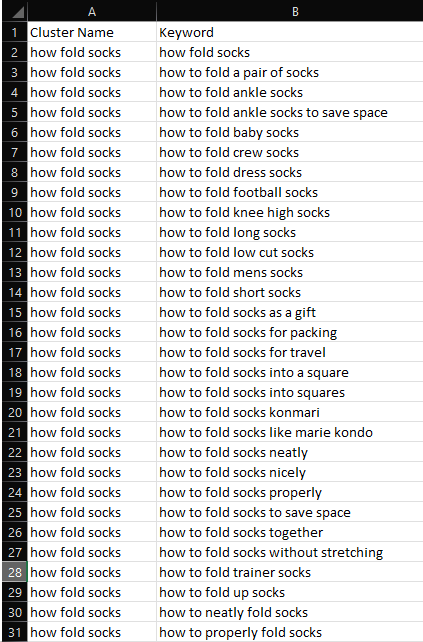
This plot is mostly valid for big websites with a lot of pages that can ramp up a lot of clicks over time. Instead of concentrating on a few great pages, you should try grouping articles and optimize those pages that don't get hit frequently. The Case For ClusteringIn many cases, you don't have clusters or you don't know how to group articles/pages... In this scenario, you need to be creative and think about the website structure. For example, how could you classify 1000 articles to track them in buckets? Well, this is what you can do:
The 1st approach is the most common if the website already has some sort of tagging structure. In all the other cases, you can use the 2nd approach to classify pages as best as you can.
I recommend scraping the content to see if there are overlaps. In practice, this is computationally expensive so you may want to group by URLs, in most cases. N.B. This use case will be covered in the future. Storing Content DataThe biggest favor you can do for your future self is to store content data. But Marco don't we already have Google Search Console? No, I am talking about something more "exclusive" that you always see me mentioning. Every article should be featured along with some metadata and additional information, such as:
This is what you can use to join with GSC and GA4 data, simply invaluable.
Big publishers tend to do this quite often because they need to have this kind of information. This is the bare minimum to get started today! Takeaways & What You Can Do TodayYou don't need a full staff and a content manager to get better at Operations. I recommend you start as soon as possible with few resources and try more complex projects later on. For example, you could:
For small projects, the latter is simple to do and I really really invite you to do so. You can't analyze individual articles for bigger projects and that's why I insist on grouping pages. 👥 Join Our CommunityOur Discord community offers a small place where we can talk business and SEO. If you hate all the noise of social media, then this place is for you.
🔎 Analytics For SEO Ebook (v6)This ebook is aimed at SEOs or Business Owners who want to explore the combination of SEO and Analytics. If you want to start building your data empire, this is the (initial) path to take. It will teach you or your employees to: 👉 Avoid common pitfalls that cost you money 💸 👉 Create meaningful analyses that add value 💯 👉 Shorten the learning time of Analytics ⏳ This comes with monthly updates because I want to create the Ultimate Guide out there. v6 includes the following information: ✅ Strategy in terms of SEO & Data ✅ Decision Making ✅ Integrating Data with SEO
v7 will include additional info on DataViz and topics on request. 📚 Recommended Reads - Peak Content 🗻Here are some resources to learn more about the "complex" world of content. You can simply start today by defining some basic operations (e.g. update process, streamlining writing, etc.) and then expand your knowledge:
📞 One-Hour CallIf you have doubts about SEO or Analytics, you can book a call with me. Have doubts about your content website or with your data? Look no further, I can help you:
❗️ Feedback and RecommendationsIf you have ideas/recommendations for the next issues of Seotistics, you can simply reply to this email. Marco Giordano Follow me on 🔽🔽🔽: |



Bernerstrasse Süd 169, Zurich, Switzerland |
Seotistics - Web Analytics + Business + Strategy
The Seotistics newsletter is written by Marco Giordano, a Data/Web Analyst with the goal of combining business and web data. Tired of the usual boring Analytics content without any business impact? Seotistics teaches you how to use Analytics, web data and even content in your workflow while helping you with Strategy.
Use Data Or Be Used By Data! The October 26 issue of Seotistics is here for you! You read a lot of stuff online decreting the end of SaaS, GA4 and whatever due to AI. Most of it is wrong and shouldn't affect your work or career. I will show and explain you why. Just came back from Athens from SEO On Stage, will post more details on LinkedIn. Please move this email to your Primary inbox or reply to it. This is to prevent Seotistics goes into spam by accident. Gmail users can read this tutorial...
Use Data Or Be Used By Data! The October 19 issue of Seotistics is here for you! I am just back from Rome and AI didn't sleep, we are full of news and updates. As you know if you are working with automation, you need to know this stuff! As I try to recover from multiple conferences in a row, here is the latest summary of what's going on. Most of these topics will be expanded in the next issues as they are too new 💀 Please move this email to your Primary inbox or reply to it. This is to...
Use Data Or Be Used By Data! The October 12 issue of Seotistics is here for you! Measurement did change in the last year and I am here to remind you some basic facts. AI is for sure one of the main culprits but not the only one. I am also writing a huge article on LLM measurement, stay tuned 👀 Hectic week, too much to do, including course updates. Please move this email to your Primary inbox or reply to it. This is to prevent Seotistics goes into spam by accident. Gmail users can read this...